Why Sleep YouTube Audiences Don’t Subscribe (And How to Fix It)
Faceless YouTube · 13 min read
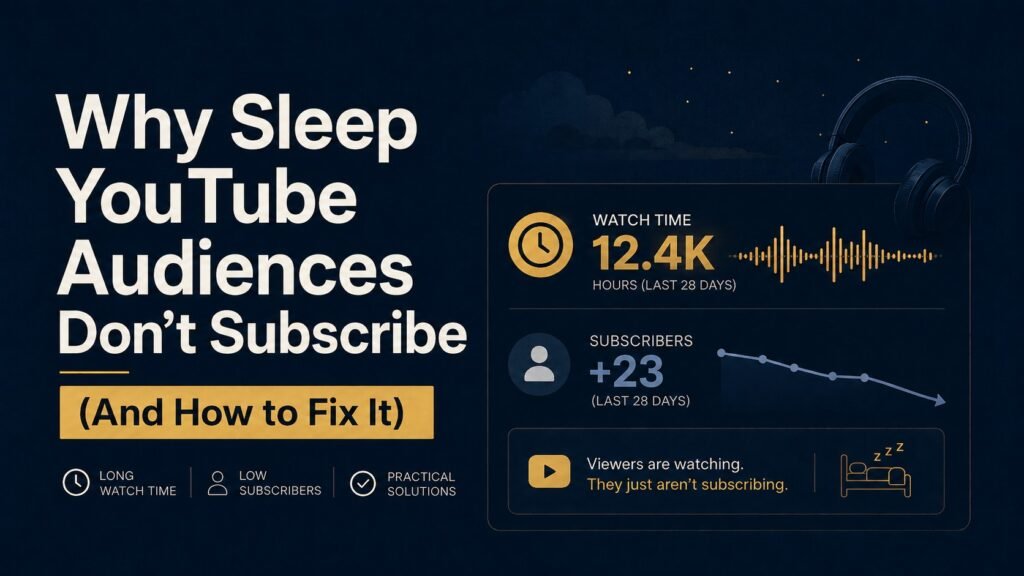
Here’s a curious thing about sleep YouTube: the channels with the most watch time often have the fewest subscribers.
A successful rain-sounds channel might rack up 50,000 watch hours a month from people falling asleep to its videos. Most of those people will never subscribe. The conversion rate from “viewer who watched 3+ hours of a video” to “subscriber” is, anecdotally, somewhere between 0.05% and 0.3% for sleep content – roughly an order of magnitude worse than typical YouTube niches.
If you’ve started a sleep channel and noticed your subscriber count growing painfully slowly compared to your watch hours, you’re not doing anything wrong. The format itself works against subscription. But it’s not unsolvable. The channels that have grown to hundreds of thousands of subscribers in this niche have done specific things – small things – that the rest of the field hasn’t.
This is what those things are.
The mechanic that breaks subscriber growth
To understand why sleep audiences don’t subscribe, you have to understand what they’re doing when they watch.
A typical YouTube viewer watches a video the way you’d expect – sitting in front of a screen, paying attention, scrolling through the comments, occasionally clicking around. At the end of the video, they’re alerted, the suggested videos appear, and if they liked what they watched, there’s a moderate chance they’ll subscribe before clicking the next thing.
A sleep viewer does none of this. They open the video at 11 pm, hit play, and within 15 minutes, they’re asleep. The screen goes dark, the phone locks, and the video keeps playing for 7 more hours in the background. When they wake up, the video has ended. They don’t return to YouTube; they get out of bed. There is no end-of-video moment where they’re prompted to engage. The “did you enjoy this?” feedback loop never fires.
This is the fundamental mechanic that breaks subscription for sleep content. The viewer never has a conscious decision point. They’ve consumed eight hours of your content but never had a moment to think, “I should subscribe.”
Most other YouTube formats embed the subscription prompt into the natural rhythm of viewing. End cards. Pinned comments. “If you enjoyed this, subscribe.” All of these depend on the viewer being awake at the right time. Sleep audiences aren’t.
So you have two options. You can accept the slow subscriber growth as a cost of the niche. Or you can engineer the channel so that the viewer encounters the subscription invitation before they fall asleep, when they’re still consciously deciding whether your channel is worth coming back to.
The big sleep channels do option two. Here’s how.
The first 90 seconds is your only chance
For a sleep video, everything that matters for subscription happens in the first 90 seconds. After that, the viewer is gone – not because they’ve left, but because they’ve stopped paying attention. This is the window.
Watch the openings of the top 20 channels in any sleep niche – rain, ocean, fire, train, white noise – and you’ll see the same patterns repeated. They’re not accidental.
The first 5-10 seconds: visual hook. A striking image of the soundscape’s theme – a vintage train emerging from mist, ocean waves at golden hour, rain on a wooden cabin. This is what gets viewers to stop on the thumbnail rather than scroll past, and it confirms in the first moments that they’ve found what they wanted.
The next 30-45 seconds: a brief spoken introduction. Not a voiceover sermon – just a calm, slow, settling voice that establishes the channel’s character. “Settle in for eight hours of vintage train sounds. No music, no interruptions. Just rhythmic wheels and distant horns.” This 30-second moment is where the viewer’s conscious brain is still active. It’s the only window where a subscription decision can form.
Seconds 60-90: the explicit ask, embedded in the experience. Not “smash that subscribe button!” – that’s the wrong register for the niche entirely. Instead: a calm, conversational invitation. “If this helps you sleep tonight, the channel publishes a new long-form soundscape every Sunday. Subscribing is the easiest way to find them again.” That’s it. Said once, gently, while the viewer is still awake enough to act.
After 90 seconds: silence. The visuals fade to black. The voiceover ends. The audio becomes the experience. No further interruptions for the next seven hours and fifty-eight minutes. The viewer can sleep.
This compresses everything that matters into a 90-second window. The rest of the video is the actual product. The first 90 seconds is the marketing.
What doesn’t work
A few approaches that look reasonable but consistently fail in this niche.
Subscribe prompts at the end of the video. No one is watching at the end. They’ve been asleep for seven hours and forty minutes. The end card might as well be invisible.
Mid-roll subscribe asks. Some creators try to insert “if you’re still awake, please subscribe!” four hours in. This wakes people up – exactly the opposite of what you want. Sleep audiences will leave you angry reviews for this. Don’t do it.
Standard “smash that subscribe button” energy. The register matters. Sleep audiences are choosing your channel partly because you’re calm. A high-energy CTA breaks the spell. The big sleep channels speak slowly, quietly, with long pauses. Any subscribe ask has to match that texture.
Pop-up subscribe overlays. YouTube allows these. Don’t use them in sleep content. They flash on screen, break the meditative quality of the experience, and signal to the viewer that they’re consuming content rather than relaxing. Counterproductive.
Begging in the description. Almost no one reads sleep video descriptions. They’ve fallen asleep. The description matters for SEO and for the rare alert viewer in the first minute, but as a subscriber-conversion lever, it does nothing essentially.
Counting on the algorithm. YouTube’s algorithm will surface your videos to more people if they perform well, but it won’t help with the subscriber-to-watch-time ratio. That ratio is set by what you do in those first 90 seconds, not by what YouTube does after.
What actually works (beyond the 90-second window)
The 90-second opening is the single biggest lever, but there are smaller compounds that matter too.
A consistent visual identity for the channel art and thumbnails. Sleep viewers often subscribe weeks after first finding the channel – they listened, slept well, came back the next night, listened again, slept well again, eventually subscribed on visit three or four. For that pattern to work, your videos have to look unmistakably yours when they appear in search results. The big sleep channels have identifiable thumbnail styles you can recognise from a thumbnail strip alone. Build one for yours.
Naming conventions that signal the channel, not just the video. Compare “8 hours of rain sounds” (generic, could be any channel) to “Vintage Train Sounds for Sleep · No Music, No Ads” (the second is a brand signal, not just a description). Returning viewers find you through pattern matching on your title format. Make yours recognisable.
Publishing schedule that creates anticipation. Sleep audiences are slower-burning than typical YouTube audiences, but they do build habits. If you publish every Sunday evening, the subset of viewers who liked your last video and remembered you exists will return Sunday evening. This is genuinely a small subset for the first 50 videos. It compounds over the next 200.
A real channel identity, articulated somewhere. Most sleep channels have no “About” page worth reading. The ones that grow tend to have one – a short statement of what the channel is for and what they won’t do. “Long-form soundscapes for sleep and focus. No music, no narration after the first 60 seconds, no ads inserted mid-video. Eight-hour videos, weekly, on Sunday evenings.” This 30-word manifesto, in the About section and in the description of every video, is what alerts viewers to recommend you to friends.
A coherent set of related videos in the same niche. Sleep viewers want a library, not a viral hit. A channel with 30 thoughtful videos in a single niche outperforms a channel with 5 viral videos across multiple niches. A subscription is a bet on future content; it only works if that content is predictable.
The contrarian move: don’t optimise for subscriptions
Once you’ve handled the first 90 seconds and the broader identity work, there’s a more interesting question worth asking: should you actually be optimising for subscriptions at all?
The honest answer for sleep content is partly no.
The metric that drives sleep channel revenue is watch time, not subscriber count. A channel with 5,000 subscribers and 500,000 monthly watch hours earns dramatically more than a channel with 50,000 subscribers and 100,000 monthly watch hours. YouTube pays you for time, not for follower lists.
Subscribers do matter – they smooth out the discovery problem (returning viewers don’t have to find you again), they signal to YouTube that your content is valued, and they form the basis of any eventual product or off-platform audience. But they’re not the right primary metric for sleep content.
The primary metrics are average view duration and total watch hours per video. Both of those are best optimised by making your videos genuinely good for sleep – high audio quality, no jarring transitions, no mid-roll surprises, consistent volume throughout, proper LUFS mastering, faded outros that don’t wake people.
A helpful reframe: a sleep channel isn’t really running on the YouTube algorithm in the same way a finance or fitness channel is. It’s running on its own internal economy, where the audience’s literal sleep quality is the conversion event. Optimise that, and watch hours follow. Watch hours, in turn, generate the algorithm boost and the slow subscriber drip.
So the real answer is two-layered: handle the 90-second subscribe window because it costs you nothing and recovers a real conversion that would otherwise be lost. Then don’t lose sleep over the subscriber count itself. Focus on making the actual product – the sleep audio – genuinely good. The numbers compound differently in this niche than they do anywhere else on YouTube, and that’s actually an advantage if you’re patient.
The expectation reset
If you’ve launched a sleep channel and you’re three months in with 30 subscribers and 12,000 watch hours, here’s what those numbers actually mean.
The 30 subscribers is normal. Below average, but inside the normal range. Don’t panic, don’t change everything.
The 12,000 watch hours is what’s interesting. That number means real people genuinely used your videos to sleep. Watch hours, more than any other metric, prove that the content works. If you have hours but not subscribers, the content is doing its job – the platform’s subscription mechanic just isn’t capturing it.
The right response is not to chase subscribers. It’s to keep publishing, hold the 90-second subscribe window in place, and let the slow compounding happen. Most sleep channels that eventually grow to 100,000+ subscribers spent their first 12-18 months in the “high watch hours, low subscribers” pattern. The ratio improves not because they cracked some growth hack, but because the back catalogue grows. With 30 videos in your library, returning viewers have variety; with 5 videos, they’ve heard everything you make.
If you’re impatient with the subscriber number, the temptation is to do one of two things: (1) over-engineer the channel with subscribe prompts, end screens, asks-for-comments, and other engagement mechanics that don’t fit the niche, or (2) abandon the niche entirely and start a different channel. Both make the underlying situation worse.
The boring, slow, correct answer is to publish weekly for 12 months and reassess. If the videos are good, the watch hours will be good. If the watch hours are good, the subscribers will eventually arrive.
A starter checklist
If you’re building a sleep channel from scratch – or trying to fix subscriber growth on an existing one — these are the concrete things to put in place:
- A 30-60-second spoken intro on every video, with a calm, tone-matched subscribe ask in the first 90 seconds.
- A consistent visual style for thumbnails that’s recognisable across your library at a glance.
- A naming convention that signals “this is a [channel name] video”, not just “this is a rain video.”
- A short channel manifesto in your About section and pinned to your video descriptions – 30 words on what your channel is for.
- A publishing schedule you can sustain. Weekly is the upper bound for most solo creators. Monthly is fine. Erratic is the killer.
- A library plan – 30 videos in the same niche, not 5 viral attempts across niches.
- Watch-time optimisation as the primary metric. LUFS-mastered audio, no jarring cuts, consistent volume across the full runtime, calm faded outros.
Subscribers come slowly in this niche. They come, but slowly. The channels that get there are the ones that built the right foundations early, then waited.
Want the full sleep-channel production guide, plus the 30-day launch plan and the prompt library for thumbnails and titles? It’s all in the free Hidden Hustles Starter Kit – three guides, no upsells, no surprise course at the end.
Some tools mentioned in this article are affiliate partners – we earn a small commission if you sign up via our links. We disclose every affiliate explicitly, and our recommendations don’t change based on commissions. See our affiliate disclosure for more.